
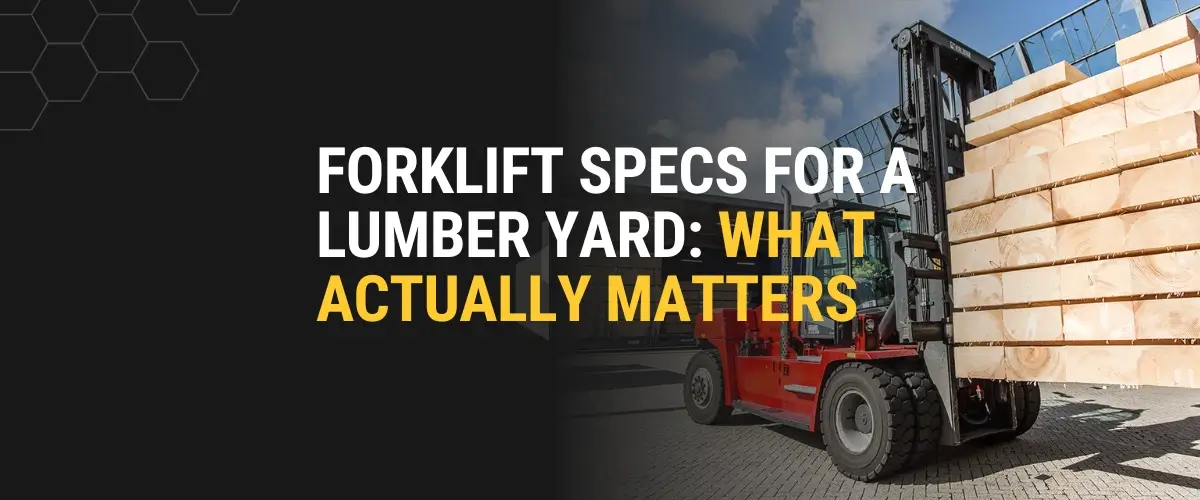
Forklift Specs for a Lumber Yard: What Actually Matters
Written by a Thompson Lift Truck Forklift Expert • Updated May 15, 2026
Quick Facts: Forklift Specs for a Lumber Yard
- Capacity range: most lumber yards need forklifts in the 8,000 to 15,000 lb range, with heavier units for engineered wood and bundled long lumber
- Pneumatic tires only: cushion tires belong on warehouse floors, not gravel or asphalt
- Fuel type: Diesel and LPG are the two practical choices. Electric is rare in full outdoor yard work without significant infrastructure
- Specs beyond capacity: fork length, mast configuration, ground clearance, and attachments matter as much as raw lift rating
- Biggest risk: under-spec’ing a yard truck is one of the fastest ways to create a stability and tipover problem
Looking for a Forklift for a Lumber Yard?
A lumber yard punishes equipment that wasn’t built for it.
Bundled lumber is heavy, long, and rarely stacked perfectly square. The ground is a mix of asphalt, gravel, dirt, and whatever the last rain left behind. Loads shift. Operators turn tight against fences and trailers. And the trucks that work fine in a clean warehouse end up burning hydraulic pumps, eating tires, or tipping a unit of 2x4s before lunch.
Picking a yard truck is a specs problem, not a brand problem. The right forklift specs for a lumber yard match the load weights, the surface, and the way the yard actually moves product. Get those numbers wrong, and you pay for it in damaged inventory, downtime, and operator turnover.
This guide goes deeper into the specs side of equipment selection. For a broader overview of equipment across the entire timber chain, from harvest sites to sawmills to distribution yards, our hub page on forklifts for timber and forestry operations covers the full picture.
What lift capacity does a heavy-duty forklift for a lumber yard need?
Most lumber yards need a heavy-duty forklift in the 8,000 to 12,000 lb capacity range, with operations handling longer or denser product moving up to 15,000 lbs or more. That’s the short answer. The reason it gets picked too small so often is that buyers spec for the average load, not the heavy one.
A standard unit of 2x4x8 lumber weighs roughly 1,800 to 2,200 lbs, depending on species and moisture content. A unit of 2x10x16 can push past 3,500 lbs. Engineered wood, treated lumber, and hardwood bundles run heavier still. By the time you stack a second bundle, add packaging, or pick up dense product like LVL or cement board, you’re well past what a 5,000 lb truck should be carrying.
Capacity ratings also drop fast at higher load centers. A truck rated at 10,000 lbs at a 24-inch load center might only carry 7,000 lbs at 36 inches, which is closer to where a unit of long lumber actually sits. If you’re not sure where your loads fall, weigh a few representative units before you spec a truck. Guessing is how operators end up running at the edge of the data plate every day.
What mast configuration works best for an outdoor forklift for lumber?
An outdoor forklift for lumber usually needs a two-stage or three-stage mast with enough free lift to clear covered storage areas. Three-stage masts are the most common because they give you reach without a giant lowered height, which matters when the truck moves between an outdoor yard and a covered shed.
Mast specs come down to two questions. How high do you stack, and what do you have to drive under? Most yard storage racks run between 12 and 20 feet. That puts you firmly in two-stage or three-stage territory.
Free lift is the spec people forget. Free lift is how high the forks can rise before the mast starts extending. In a lumber yard with low overhead beams or a covered storage shed, you need enough free lift to load the bottom rack without the mast hitting the ceiling. Quad masts handle this well in tight, covered storage. Standard duplex masts often don’t.
When a dealer is configuring a truck, ask for the lowered height, extended height, and free lift as three separate numbers.
Why a pneumatic tire forklift is the only outdoor option
A pneumatic tire forklift is the only outdoor option for a lumber yard. Cushion tires are designed for smooth concrete, and they fail on every other surface a yard creates: gravel, dirt, asphalt with debris, and uneven ground. They wear out fast, lose traction, and turn every load into a stability problem.
Our forklift tire wear and surface type guide covers the wear math in more detail, but the short version is that the wrong tire on the wrong surface is one of the fastest preventable costs in any yard fleet.
Within pneumatic, you have two real options:
- Air-filled pneumatics give a smoother ride, better shock absorption over rough ground, and are usually cheaper. They can also go flat
- Solid pneumatics can’t be punctured by nails, screws, banding scrap, or any of the other debris that ends up on a lumber yard surface. They cost more upfront and ride a little stiffer
Most established lumber operations end up running solid pneumatics for the puncture resistance alone. The math works out faster than people expect once you count downtime from a flat. For yards with truly rough or uneven ground, a rough terrain forklift with deep-tread pneumatics is the right call instead.
Diesel vs LPG forklift for outdoor yards: which one fits?
For a diesel vs LPG forklift outdoor decision in a lumber yard, diesel wins for heavy loads and long shifts, while LPG fits smaller yards with shorter run times. Electric forklifts can work in covered or paved building materials operations, but full outdoor yard work in the Southeast generally isn’t where electric earns its keep yet.
Diesel wins on torque, run time, and pulling heavy loads up grade. If your yard is large, your loads are heavy, and your forklift runs full shifts without easy access to a fuel exchange, diesel is usually the right call. Diesel trucks also tend to outlast LPG units in heavy-duty applications.
LPG is the better fit for smaller building materials yards, mixed indoor and outdoor operations, and yards where tank swaps are easy and fast. LPG trucks are cleaner, quieter, and a little less expensive on the front end. They lose ground to diesel under sustained heavy loads.
Our internal combustion forklift lineup covers both fuel types across the capacity range most lumber yards need.
What fork length do you need for unit lumber?
The right fork length for unit lumber is 60 to 72 inches for most lumber yards, with longer specs for specialty operations. Standard 42 or 48-inch forks are wrong for unit lumber. They’re too short to support the load safely, and they leave product hanging off the tips, which is where damage and tipovers come from.
The forks should support the load across at least two-thirds of its length. If they don’t, you’re loading the fork tips, not the heel of the fork, and stability drops fast.
If you don’t want to commit to long forks full-time, fork extensions are a practical option for occasional long-load work. They slide over the existing forks and lock in place. They’re not a substitute for properly spec’d forks on a truck that handles long loads every shift.
Which attachments matter most on a lumber yard forklift?
The four attachments that earn their cost fastest in a lumber yard are side-shifters, fork positioners, lumber clamps, and carpet poles. Each one solves a specific handling problem that comes up every shift.
- Side-shifters let operators slide the forks left or right without repositioning the whole truck. On a busy day, they save hundreds of small moves and a lot of damaged banding
- Fork positioners adjust fork spacing from the operator’s seat. Useful when you’re switching between unit lumber, plywood, and pallets without stopping to manually reset the forks
- Lumber clamps and bundle squeezes grip a unit from the sides instead of relying on fork support alone. They’re a serious upgrade for yards moving high volumes of bundled product
- Carpet poles or boom extensions handle long roll goods, pipe, and specialty items that don’t sit on forks well
Our forklift attachments guide covers configuration and capacity adjustments in more detail. One thing worth flagging: every attachment changes the truck’s effective load capacity. Any reputable installation includes a recalculated capacity plate. If a dealer skips that step, find a different dealer.
What other forklift specs for a lumber yard get overlooked?
The three most-overlooked forklift specs for a lumber yard are ground clearance, counterweight, and cooling system. None of them leads a brochure, and all three decide whether a truck holds up in real outdoor conditions.
- Ground clearance: Yard surfaces are uneven. Gravel piles, drainage ridges, and rutted approaches are all routine. A truck with low ground clearance hangs up on terrain that a properly spec’d yard truck drives over without thinking about it.
- Counterweight and stability: Heavy loads at long load centers need a real counterweight to stay safe. Under-spec’ing the truck so it sits at the edge of its stability triangle every shift is how lumber yards end up with tipover incidents.
- Cooling system: Southeast summers are brutal on diesel and LPG forklifts running full shifts in the sun. Heavy-duty radiators, properly sized fans, and clean intakes are the difference between a truck that runs all day and one that overheats by 2 PM in August.
When does a standard counterbalance forklift stop working for a lumber yard?
A standard counterbalance forklift stops working when loads get long enough to exceed safe fork support, when aisles get tight enough that the truck can’t turn with a unit on the forks, or when surface conditions move past what pneumatic tires can handle. Two cases worth flagging:
Long-load specialists: Operations moving full units of long lumber, engineered beams, or steel through narrow lanes often outgrow counterbalance trucks. Combilift multi-directional forklifts and side loaders handle these loads with better stability and tighter aisle requirements. Our side loader forklift overview covers when this category makes sense, and the broader lumber yard forklifts page covers fit across the rest of the timber chain.
True off-road yards. Yards with significant grade, mud, or unimproved surfaces need rough terrain forklifts (Class VII) instead of standard pneumatic-tire trucks. Class VII machines with four-wheel drive and high ground clearance handle conditions that destroy standard yard forklifts.
What are the most common forklift spec mistakes in a lumber yard?
The most common spec mistakes in a lumber yard are under-rating capacity, putting cushion tires on outdoor surfaces, and using standard-length forks on long material. All three create stability and downtime problems that aren’t obvious on day one but show up fast in damaged product, worn tires, and operator complaints.
- Buying for the average load instead of the heavy one. The truck has to handle the worst day, not the typical one
- Cushion tires on outdoor surfaces. Always wrong, always expensive
- Standard-length forks on long material. Damaged product and stability risk
- Skipping the load center math. Capacity drops at distance, and lumber loads sit far forward
- Ignoring attachment capacity adjustments. A forklift with a clamp doesn’t lift the same as one without
When should you upgrade your lumber yard forklifts?
You should upgrade lumber yard forklifts when current trucks are showing the warning signs of being under-spec’d for the work, not when they hit a calendar age. The patterns to watch for:
- Excessive tire wear or repeated flats
- Hydraulic problems showing up well before normal service intervals
- Operators routinely working at the edge of the rated capacity
- Loads that don’t fit the forks or sit balanced
- Repeated minor damage to product, racks, or trailers
- Trucks overheating in summer
Our parts and service and maintenance teams see these patterns daily, and they’re a useful early signal that a truck has been pushed past what it was designed for.
How Thompson Lift Truck helps lumber and building materials yards
Thompson Lift Truck spec’s yard forklifts for real Southeast conditions, not brochure averages. We work with lumber yards, building materials suppliers, sawmills, and outdoor industrial operations across Alabama, Georgia, Florida, and Tennessee. When a lumber yard contacts us about new equipment, the conversation starts with load weights, surface conditions, run time, and yard layout. From there, we configure capacity, mast, tires, forks, and attachments to match. We carry Hyundai, Crown, Combilift, Kalmar, Baumann, and Shuttlewagon for new equipment, plus a full used machines inventory for operations that want a budget-friendly truck or backup unit.
Short-term needs get covered through our rental fleet, which is also a practical way to test a different spec before committing to a purchase. For a fuller view of how equipment selection differs across harvest sites, sawmills, kilns, and lumber yards, our forklifts for timber and forestry operations page maps the whole timber chain.
FAQs: Forklift Specs for a Lumber Yard
What capacity forklift do I need to handle bundled lumber?
For most bundled lumber and building materials work, an 8,000 to 12,000 lb base capacity forklift is the right starting point, with longer or denser products often pushing the requirement to 15,000 lbs or more. Capacity should always be verified at the load center your loads actually create, not the standard 24-inch rating. Thompson Lift Truck can review typical load weights and confirm the capacity needed at your real load center.
Are pneumatic tire forklifts required for lumber yards?
Yes, for outdoor work. Cushion tires wear out quickly on gravel, dirt, and asphalt with debris, and they lose traction on uneven surfaces. Solid pneumatic tires are the most common choice for lumber yards because they resist punctures from nails and banding scrap. Thompson Lift Truck stocks pneumatic-tire forklifts in the capacity ranges lumber operations need.
Is diesel or LPG a better fuel choice for an outdoor lumber yard?
Diesel handles heavy loads, long shifts, and large outdoor yards better than LPG. LPG works well for smaller building materials yards and operations that mix indoor and outdoor work. Thompson Lift Truck can compare both options based on yard size, run time, and load weights.
What fork length do I need for unit lumber?
Standard 42 or 48-inch forks are usually too short for unit lumber. Most lumber yards run 60 to 72-inch forks, so the forks support at least two-thirds of the load. Longer forks are common for specialty operations. Thompson Lift Truck can spec the correct fork length based on the products you handle.
Which attachments are most useful on a lumber yard forklift?
Side-shifters, fork positioners, lumber clamps, and carpet poles are the most practical attachments for lumber and building materials operations. Each one changes the truck’s effective load capacity, so the data plate has to be updated after installation. Thompson Lift Truck installs and re-rates attachments to keep trucks compliant.
What free lift does a forklift need for a covered lumber shed?
Free lift is the height the forks can rise before the mast starts extending, and it determines whether you can load the bottom rack inside a covered shed without the mast hitting the ceiling. Quad masts handle low-overhead covered storage well; standard duplex masts often don’t. Thompson Lift Truck can match free-lift height to your specific shed clearance.
What’s the most common spec mistake when buying a forklift for a lumber yard?
Under-rating capacity for the heaviest loads, paired with cushion tires on outdoor surfaces. Both create stability and downtime problems that aren’t obvious on day one but show up fast in damaged product, worn tires, and operator complaints. Thompson Lift Truck reviews load weights and surfaces upfront to avoid these issues.