
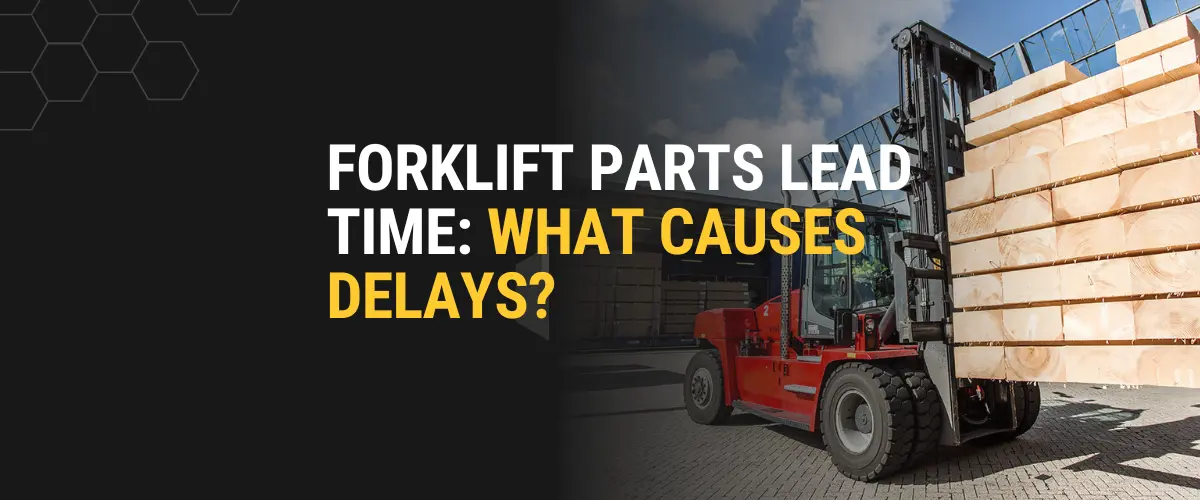
Forklift Parts Lead Time: What Causes Delays?
Written by a Thompson Lift Truck Forklift Expert • Updated March 20, 2026
Quick Facts: Forklift Parts Lead Times
- Lead times vary significantly depending on part type, brand, and whether it’s OEM or aftermarket
- Serial number accuracy is one of the most common causes of ordering errors and delays
- High-wear parts ordered reactively cost more time and money than the same parts ordered preventively
- Regional dealer inventory can cut days or weeks off a lead time compared to ordering direct
- Thompson Lift Truck stocks OEM parts and can cross-ship between branches across the Southeast
Waiting on Forklift Parts?
You put in a parts order and the estimated arrival is three weeks out. The forklift is sitting. The shift is short a truck. And nobody has a clear answer on why it takes that long.
Forklift parts lead times are not random, but they’re also not consistent. A hydraulic filter might ship same day. A specific control module for an older model could take weeks. Understanding what drives those differences helps maintenance teams plan better and avoid getting caught off guard when something critical breaks.
What Actually Drives Forklift Parts Lead Times
OEM Manufacturing and Production Cycles
Original equipment manufacturer parts are built to exact specifications for specific machines. They’re not produced on a continuous rolling basis. Many OEM components are manufactured in batches, and when a batch sells through, the next production run may not happen for weeks or months.
This is especially common for electronic components, specialized hydraulic parts, and anything tied to an older or lower-volume model. The part exists, it will be available again, but the timing depends on a manufacturing schedule that has nothing to do with when your forklift broke.
Working with an authorized dealer who carries OEM stock regionally is one of the most reliable ways to avoid sitting in that queue. Our forklift parts team maintains OEM inventory across our Southeast branches and can check availability before you commit to a wait. This applies across the brands we carry, including Crown and Hyundai, where we have direct OEM relationships.
Global Supply Chain Disruptions
Most forklift components are not manufactured domestically. Electrical systems, hydraulic components, and specialty hardware are sourced from manufacturers in Asia and Europe. Port delays, customs holds, and freight bottlenecks all add time to a parts order that was already in transit.
These disruptions are not always predictable and they’re not always visible until a shipment is already late. A dealer with established distribution relationships and regional stock buffers is better positioned to work around them than someone ordering one-off from a national catalog.
Backordered Components
Some parts are simply backordered. The order is in the system, but fulfillment depends on restocking.
This is one of the more frustrating lead time situations because the timeline is genuinely unknown. The best mitigation is identifying which parts on your fleet are high-wear and likely to need replacement, and stocking at least one spare before the failure happens. Our forklift parts guide covers the components that wear out most often and what to watch for before they fail.
Serial Number Errors and Ordering Mistakes
A wrong serial number means a wrong part. A wrong part means the forklift stays down while the right one gets ordered and the original gets returned.
This happens more than it should. Serial numbers on older machines can be worn or partially obscured. Ordering from memory or from a generic parts list rather than the actual unit is a common source of error.
Whenever you’re ordering parts, verify the serial number directly from the machine. Our guide on how to identify forklift parts walks through how to locate serial numbers and use them correctly to pull the right component the first time. If you’re troubleshooting a Hyundai unit and need to pinpoint what’s actually failing before you order, our Hyundai fault codes guide is a useful starting point.
OEM vs Aftermarket Availability
OEM vs aftermarket is a decision most maintenance teams face regularly. OEM parts are sourced through the manufacturer’s supply chain and are brand and model specific. Aftermarket parts are produced by third-party manufacturers, are often more readily available, sometimes stocked locally in larger quantities, and usually less expensive.
The tradeoff is fit and warranty. OEM parts are guaranteed to spec. Aftermarket parts vary in quality and may not carry the same warranty coverage. For some applications, aftermarket is a practical choice. For others, particularly warranty-covered machines or safety-critical components like hydraulic systems and steering parts, OEM is the right call.
Lead time is often shorter for aftermarket. If uptime is the priority and the application supports it, an aftermarket part that ships today is worth considering over an OEM part that ships in two weeks. Downtime costs more than the price difference on the part.
Regional Stocking and Dealer Inventory
Not all dealers stock the same parts. A national distributor may have a part in a warehouse three states away. A regional dealer with branches near your facility may have it on the shelf today.
This is a real operational difference. Our parts department stocks over $3M in OEM and aftermarket inventory across our Southeast locations and we can cross-ship between branches when one location has stock and another doesn’t.
How to Reduce Exposure to Long Lead Times
Identify your high-wear parts now. Every forklift has components that wear out on a predictable schedule. Tires, filters, brake pads, forks, hydraulic hoses, and battery components all have known service intervals. If you’re ordering these reactively, you’re adding lead time to every repair. Identify the high-wear parts for each unit in your fleet and keep at least one replacement on hand. Our forklift preventive maintenance guide covers service intervals in detail and is a good starting point for building a stocking list. A structured maintenance and service plan makes this even easier to manage across a whole fleet.
Know your serial numbers before something breaks. Pull the serial number for every unit in your fleet and keep it somewhere accessible. When a part is needed, the serial number should be the first thing your tech grabs, not something they have to go find while the clock is running. This single habit eliminates one of the most common sources of ordering delays.
Build a relationship with a regional dealer. A dealer who knows your fleet and your machines can flag parts availability before it becomes a problem. That relationship also means faster response when something urgent comes up. Regular service and maintenance through the same dealer builds that picture over time and our technicians know what’s due and what’s wearing faster than expected.
Don’t wait until failure to order worn components. If a component is showing early wear during an inspection, order the replacement before it fails. Our OSHA forklift inspection guide and how often to inspect a forklift both cover what to look for during routine checks. Catching wear early is where most emergency parts orders get avoided.
How Thompson Lift Truck Helps Reduce Parts Downtime
Our parts department carries OEM and Promatch aftermarket inventory across our Southeast branches, with direct relationships with Crown, Hyundai, Combilift, and Kalmar. When a part isn’t available at one location, we check across branches and cross-ship to reduce wait time.
We can verify availability, confirm the correct part number using your serial number, and give you an accurate lead time upfront so you’re not planning around a date that isn’t real.
If your unit is down and the repair is going to take longer than expected, a short-term forklift rental can keep your operation moving while you wait on parts.
Waiting on forklift parts? Contact Thompson Lift Truck about local inventory and faster sourcing options.
FAQs: Forklift Parts Lead Times
Why do forklift parts take so long to arrive?
Lead times depend on whether the part is OEM or aftermarket, local stock availability, and whether supply chain or freight delays are involved. OEM parts for older or lower-volume forklift models tend to take the longest due to manufacturer batch production cycles. Thompson Lift Truck can check availability across Southeast branches before you commit to a wait.
What causes a forklift part to be backordered?
Backorders happen when demand exceeds available stock and the next production run or shipment hasn’t arrived yet. Parts sourced from overseas manufacturers and high-demand components are the most common ones affected. Thompson Lift Truck stocks OEM and aftermarket forklift parts across the Southeast and can often source faster than ordering direct.
How do forklift serial number errors cause parts delays?
Using the wrong forklift serial number means the wrong part gets ordered and shipped. The correct part then has to be reordered from scratch, doubling the lead time. Thompson Lift Truck verifies the correct part against your forklift’s serial number before anything is ordered. Our guide on how to identify forklift parts covers where to find serial numbers on your machine.
How can I reduce downtime while waiting on forklift parts?
Stock high-wear replacement parts before they’re needed rather than ordering reactively. A short-term forklift rental can also cover operational gaps while a repair is pending. Thompson Lift Truck offers both parts sourcing and rental options across the Southeast.
Does the forklift brand affect parts lead time?
Yes. Parts for high-volume brands are more widely stocked than parts for older or lower-volume models. Thompson Lift Truck has direct OEM relationships with Crown and Hyundai and carries parts inventory across Southeast branches.
What’s the fastest way to get a forklift part in the Southeast?
Working with a regional dealer who carries local stock cuts days or weeks off a lead time compared to ordering through a national distributor. Thompson Lift Truck stocks forklift parts across multiple Southeast locations and can cross-ship between branches. Contact our team to check availability.
Can Thompson Lift Truck source forklift parts faster than ordering direct?
In many cases, yes. Thompson Lift Truck stocks OEM and aftermarket parts across Southeast branches and can cross-ship between locations. Our parts team verifies availability and confirms the correct part number using your forklift’s serial number before you commit to an order.