
Loading Dock Safety: Where Forklift Incidents Actually Happen
Written by a Thompson Lift Truck Forklift Expert • Updated July 2026
Quick Answer: Loading Dock Safety for Forklifts
Quick answer: most dock incidents come from the trailer moving, the dock plate failing, or the trailer floor giving way. Chocks are the minimum standard, restraints are the stronger control, and neither is something an operator can fix from the seat.
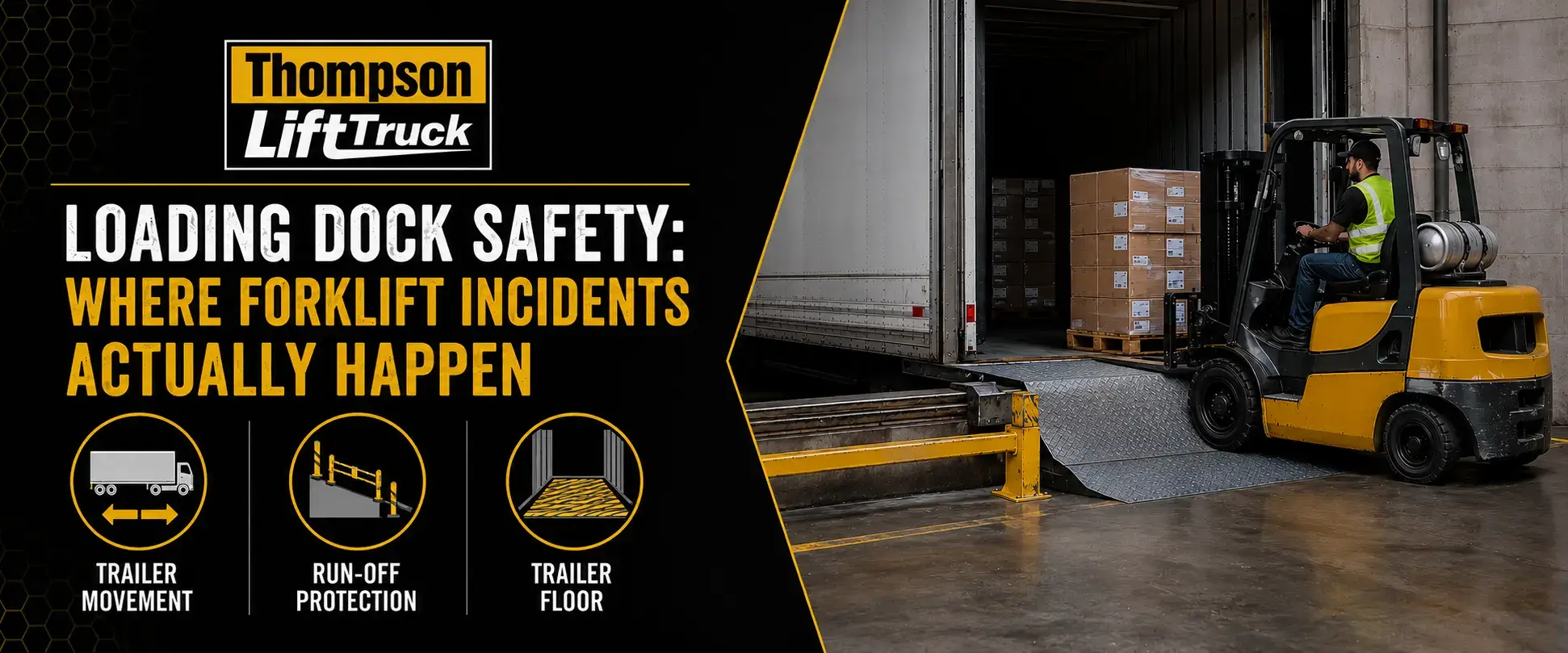
- Trailer movement is the main hazard. OSHA requires the brakes set and wheel chocks placed under the rear wheels before a forklift boards a trailer.
- A restraint beats a chock. OSHA accepts a positive mechanical means of securing the trailer to the dock as equivalent protection, provided it actually prevents movement.
- Dock plates need run-off protection. Dockboards put into service from January 2017 have to be built and maintained to stop a truck running off the edge.
- Check the trailer floor first. The flooring of trucks and trailers must be checked for breaks and weakness before a forklift drives onto it.
- Most of this is bought, not taught. An operator cannot fix a worn leveler, a missing restraint, or a soft trailer deck.
Reviewing Your Dock Setup?
Why do so many forklift incidents happen at the loading dock?
The dock is the one place where a forklift leaves a surface you control and drives onto one you do not. Everything on the warehouse side is yours: the floor, the lighting, the layout, the truck. The trailer is a different vehicle, loaded by someone else, on suspension you cannot see, and it can move. That handover is where the risk sits.
It is also the zone under the most time pressure. Drivers are on a clock and the whole operation is built around turning trailers fast, which is why dock incidents are rarely a surprise. They are usually the same three failures repeating.
What is trailer creep, and why are wheel chocks not enough on their own?
Trailer creep is the trailer walking away from the dock, a few inches at a time, as a forklift drives in and out of it. Each entry pushes the trailer forward against its suspension, and the gap between the trailer and the dock opens up. OSHA has recognized creep and pull-away as a long-standing dock problem, and the outcome is the one you would expect: the dock plate loses its purchase and drops with a loaded forklift on it.
Chocks are the baseline requirement, not the complete answer. Under OSHA 29 CFR 1910.178(k)(1), the brakes of highway trucks have to be set and wheel chocks placed under the rear wheels to stop the truck rolling while a forklift is boarding it. Chocks stop a roll. They do less about a trailer that is being pushed forward, and nothing at all about a driver who decides to leave.
When do you need a trailer restraint instead of chocks?
A restraint is warranted anywhere the consequence of trailer movement is a forklift falling, which is most docks running powered equipment into trailers. OSHA allows a positive mechanical means of securing a trailer to the dock as equivalent protection to chocks, provided it is installed and used so that it effectively prevents movement, is maintained the way the manufacturer specifies, and is taken out of service the moment it is damaged.
The difference is control. A chock depends on somebody placing it correctly every time. A restraint ties the trailer to your building and can be interlocked with your dock lights, so the driver cannot leave while the light is red. Consider one where you have:
- High trailer turnover, where chock discipline slips under pressure.
- Heavy or high-reach forklifts entering trailers, where the forces are larger.
- A sloped or icy approach apron.
- Drivers you do not employ and cannot brief.
Enforcement of chocking on commercial vehicles is more complicated than the standard reads, since jurisdiction is split and some states run their own programs. That is a reason to fit the better control, not a reason to skip it.
What should you check on a dock leveler or dock plate?
Check that it can carry your heaviest loaded forklift, that it sits flat with no rock or gap, and that it has run-off protection at the edges. Dockboards put into initial service from 17 January 2017 have to be designed, constructed, and maintained to stop a transfer vehicle running off the edge, unless you can demonstrate there is no run-off hazard at all.
On a walk-round, look for:
- Load rating you can actually read. A plate with no legible rating is a plate nobody can sign off.
- Lip condition and engagement. A worn or bent lip that does not seat properly on the trailer bed is the failure point.
- Grade and gap. A steep leveler angle changes how a loaded mast behaves. Watch a truck cross it with a full pallet and you will see it.
- Edge protection. Curbs or side barriers on the leveler itself, not just paint.
- Hydraulics and springs. A leveler that will not hold position under load is a repair, not a note for later.
How do you know if a trailer floor will hold a loaded forklift?
You won’t know until somebody looks. OSHA is direct on this: the flooring of trucks, trailers, and railroad cars must be checked for breaks and weakness before a forklift is driven onto it. Trailer decks are not rated for your equipment, they age at a rate you have no visibility of, and a soft board under a rear wheel puts the load somewhere no one planned for.
Build a look inside into the routine before the first pallet moves. Check for soft or splintered boards, previous repairs, standing water, and signs the deck has been overloaded before. Where a trailer is parked without its tractor, fixed jacks may be needed to stop it upending as a forklift moves toward the nose.
How should drivers and forklift operators communicate at the dock?
Through a system, not a shout. The failure mode is always the same: the driver believes loading has finished and pulls away while a forklift is still inside. Every reliable fix removes that judgment call from the driver and puts it under your control.
- Dock light communication. Red and green lights inside and out, wired to the restraint where you have one, so the signal and the lock agree.
- Key or paperwork control. A simple procedure where the driver hands something over and gets it back when the dock is clear.
- Clear signage at the trailer. Bilingual where your traffic warrants it.
- Brief the driver, not just your team. Half the people at your dock do not work for you, which is exactly why procedure alone is fragile.
How do you audit your own loading dock?
Walk one full trailer cycle, from the truck arriving to the forklift coming back out, and write down every point where the control depends on somebody remembering. Do it at your busiest hour, not a quiet one, because the gaps only appear under pressure.
Then split what you find into two lists, because they get solved by different budgets:
- Procedural fixes: chock placement discipline, key control, driver briefing, trailer floor checks, and adding the dock to your daily walk. These are process and operator training changes you can make this month.
- Equipment fixes: trailer restraints, leveler repair or replacement, dock lights and interlocks, bumpers, seals, and edge protection. These need a quote and a scheduled install.
If your list is nearly all procedural, look again. A dock whose only controls are things people have to remember works right up until the day it does not.
How Thompson Lift Truck helps with dock equipment
We supply the forklifts and the dock they drive across, which means we can look at the whole cycle rather than half of it. Our warehouse solutions team handles dock bumpers, levelers, seals, lifts, and shelters, along with dock doors, and we work on warehouse racking on the same sites.
That matters because dock problems and truck problems are usually the same problem. A leveler with a steep grade is hard on a mast. A dock with no restraint is hard on everybody. Reviewing your dock setup? Contact Thompson Lift Truck and we will walk the bays with you. If you are bringing equipment onto a new site, our forklift rental delivery checklist covers what to have ready before the truck arrives.
Not sure whether your dock needs a restraint or a new leveler?
Frequently Asked Questions About Loading Dock Safety
Trailer movement is the biggest cause, either the trailer creeping forward as a forklift drives in and out, or the driver pulling away before loading is finished. Thompson Lift Truck can review your dock setup and recommend the restraints and controls that stop it.
Yes. OSHA 29 CFR 1910.178(k)(1) requires the brakes of highway trucks to be set and wheel chocks placed under the rear wheels before a forklift boards the trailer. Thompson Lift Truck can advise where a mechanical restraint would give you stronger protection than chocks alone.
Trailer creep is the trailer gradually moving away from the dock as a forklift repeatedly drives in and out, which opens a gap and can drop the dock plate under load. Thompson Lift Truck supplies restraints and dock equipment that hold the trailer in place.
Dockboards put into initial service from 17 January 2017 must be designed and maintained to prevent transfer vehicles running off the edge, unless the employer can show there is no run-off hazard. Thompson Lift Truck can assess your levelers and supply replacements.
Yes. OSHA requires the flooring of trucks and trailers to be checked for breaks and weakness before a forklift is driven onto it, because trailer decks are not rated for your equipment. Thompson Lift Truck covers trailer entry in its operator training programs.
Yes. Thompson Lift Truck supplies dock bumpers, levelers, seals, lifts, shelters, and dock doors across the Southeast, alongside forklifts, service, and operator training.