
Forklift Rack Damage: How to Spot It Before a Bay Comes Down
Written by a Thompson Lift Truck Forklift Expert • Updated July 2026
Quick Answer: Forklift Rack Damage
Quick answer: Forklift rack damage is a structural problem, not a cosmetic one. Isolate the affected bay as soon as you find damage, have it assessed against the ANSI MH16.1 standard, and never weld a repair in-house.
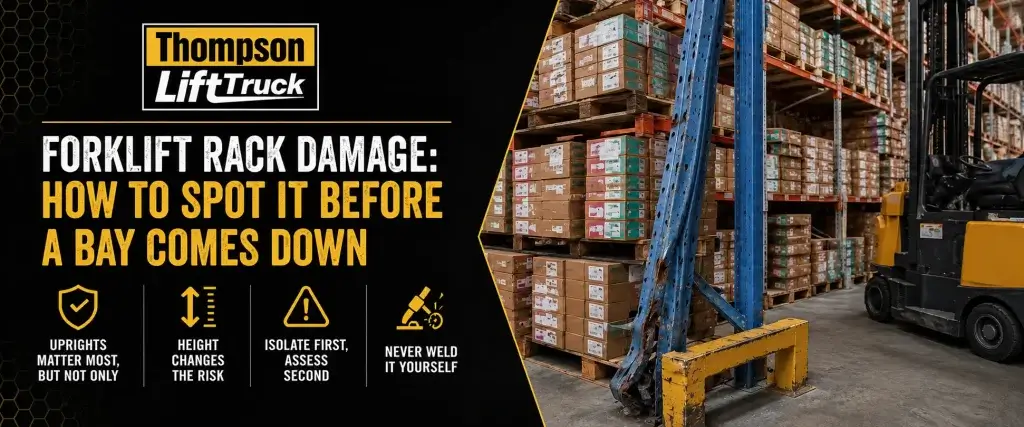
- Uprights matter most, but not only. Beams, rub rails, anchor bolts, and connections all take damage too.
- Height changes the risk. Damage at the base of an upright is more serious than the same dent near the top.
- Isolate first, assess second. The standard requires owners to isolate the affected section immediately and have it certified before it carries load again.
- Never weld it yourself. Heat changes the steel and can leave an upright weaker than the damage left it.
Racking Damage in Your Warehouse?
Most rack damage comes from forklift contact, and most of that contact happens because the truck and the aisle were never a good match in the first place. It is usually a layout that leaves no margin, repeated a few hundred times a day.
The common causes we see on site:
- Aisles that are too tight for the truck. If your aisle width was set for a different machine, every entry and exit is a near miss. Our guide to very narrow aisle forklifts covers how aisle width and truck choice should be decided together.
- Deep-reach work in bays not designed for it. Reaching two pallets deep in a rack built for single-deep storage puts the mast and the load where the frame does not expect them.
- Entry and exit angle. Most upright strikes happen on the way out, not the way in, when the operator is already turning.
- Pallet overhang. A pallet that hangs past the beam gets caught on the next pass and drags the frame with it.
- Poor visibility with a raised load. An operator travelling with forks up cannot see the base of the upright they are about to clip.
- Floor condition. Joints, cracks, and slopes push a truck off line at exactly the wrong moment.
Which types of rack damage actually matter?
The damage that matters is the damage that changes how load travels through the frame, and that is not always the damage you notice first. Uprights get the most attention, but the Rack Manufacturers Institute points out that beams, rub rails, anchor bolts, and connections all sustain damage too, and a bent anchor bolt is far easier to miss than a dented column.
Two rules change how seriously you should treat what you find:
- Position on the upright. Damage at the base of a column is more critical than the same damage near the top, because the base carries everything above it.
- Position on the beam. Damage in the middle of a beam is more critical than the same damage at either end.
What to look for on a walk:
- Dented, bowed, or twisted upright columns, especially in the bottom four feet.
- Damaged diagonal and horizontal braces, which hold the frame square even when the columns look fine.
- Deflected or sagging beams, and beams whose safety clips have been knocked out.
- Bent baseplates or loose, sheared, or missing anchor bolts.
- Missing or damaged row spacers on back-to-back runs, which tie the two rows together.
How do you inspect pallet racking for damage?
Rack inspection works best in three tiers: operators reporting damage the day it happens, a documented walk on a fixed schedule, and a qualified assessment at least once a year. The first tier is the one that fails, because nobody wants to report the dent they made.
- Daily, by operators. Make reporting a strike a no-blame, one-minute job. A culture where operators hide damage is more dangerous than the damage.
- Monthly, documented. One person walks the runs with a checklist, photographs what they find, tags it, and logs the location by aisle and bay.
- Annually, by a qualified engineer. Measurement rather than eyeballing, including column plumb, and a written assessment you can hand to an insurer.
Record the aisle, bay, and level for every finding, and photograph it. Damage that is logged and tracked gets fixed. Damage that lives in someone’s memory does not.
When should you unload a damaged rack bay?
Unload the bay as soon as you find damage you cannot confidently rule out as cosmetic, and always if a column is past the standard’s alignment limits. ANSI MH16.1 sets the maximum out-of-plumb and out-of-straight ratios for a loaded column at 1/240 of height, which works out at roughly half an inch over ten feet. Past that, the column comes out of service and gets corrected.
The sequence the standard sets out is worth following exactly, because it is also the sequence that protects you afterwards:
- Isolate the affected section of racking immediately.
- Unload it, working from the top down and from the damaged bay outward.
- Get a mitigative response underway, meaning repair or replacement.
- Have a registered design professional certify the system is back to at least its original design capacity before anything goes back on it.
If you are unsure whether a dent is cosmetic, treat it as structural until somebody qualified says otherwise. The cost of an empty bay for a week is not close to the cost of a collapse.
Can a damaged rack upright be repaired, or does it need replacing?
Both are valid, but only one is valid in-house, and it is neither. A damaged upright can be restored with a certified engineered repair kit, provided it is installed to the manufacturer’s specification and signed off by a licensed structural engineer who confirms it is back to its original rated capacity. Anything less than that is a replacement job.
The one thing you should never do is weld a repair yourself. The heat alters the metallurgical properties of the steel and can leave the upright weaker than the original damage left it, which means a repair that looks solid has quietly made the problem worse. Where documentation is thin, or the damage is extensive, replacing the component with OEM parts is the more defensible call.
How do you stop forklifts damaging racking in the first place?
Rack damage is an equipment and layout problem before it is a behavior problem, so start with the truck and the aisle rather than with the operator. A machine that fits its aisle takes pressure off everybody.
- Match the truck to the aisle. If your fleet has outgrown your layout, you are paying for it in rack repairs whether you see the invoice or not.
- Fit upright protectors and end-of-row guards. The cheapest steel in your building is the steel that takes the hit instead of the frame.
- Train for the exit, not just the entry. Our forklift operator training programs cover the pull-out and turn where most strikes happen.
- Use impact sensors. Telematics that log a strike turn unreported damage into a maintenance ticket the same day.
- Fix the floor. Joints and slopes that push a truck off line are a rack problem you can solve with concrete.
Most of these overlap with the wider picture in our guide to common forklift accidents and how to prevent them.
How Thompson Lift Truck helps with racking and forklift fit
We sit on both sides of this problem, which is unusual for a forklift dealer. We supply warehouse racking across selective, drive-in, drive-through, pallet flow, double-deep, and cantilever configurations, and we also supply and service the trucks that damage it. That means when we look at a run of bent uprights, we can tell you whether you need a rack repair, a different truck, a wider aisle, or all three.
Our warehouse solutions team works across Alabama, Georgia, Florida, Mississippi, Tennessee, Kentucky, and South Carolina. Racking damage in your warehouse? Contact Thompson Lift Truck, and we will walk the site with you.
Not sure your trucks fit your aisles?
Frequently Asked Questions About Forklift Rack Damage
Most rack damage comes from forklift contact during entry and exit, usually where the aisle width and the truck were never matched, or where pallets overhang the beam. Thompson Lift Truck can review your aisle layout and fleet together to find the mismatch causing repeat strikes.
Damage low on an upright or in the middle of a beam is more serious than the same damage higher up or at a beam end, and any column past 1/240 of its height out of plumb has to come out of service. Thompson Lift Truck can arrange an assessment if you are not sure what you are looking at.
As soon as damage is found that you cannot confidently rule out as cosmetic. ANSI MH16.1 requires owners to isolate the affected section immediately and have it certified back to its original design capacity before reloading. Thompson Lift Truck supplies replacement racking and can help you plan the reload.
No. Welding a repair in-house changes the steel’s properties and can leave the upright weaker than the damage did. Only a certified engineered repair kit signed off by a licensed structural engineer restores rated capacity, and Thompson Lift Truck can source OEM replacement components where repair is not appropriate.
Operators should report strikes the day they happen, a documented walk should run monthly, and a qualified engineer should assess the system at least annually. Thompson Lift Truck can help you build the inspection routine into your existing forklift maintenance schedule.