
Forklift Service Contracts vs Time-and-Materials: What’s Right for Your Fleet?
Written by a Thompson Lift Truck Forklift Expert • Updated June 2026
Quick Answer: Service Contracts vs Time-and-Materials
In Short: Forklift service contracts trade a fixed recurring cost for predictable maintenance and faster response, while time-and-materials lets you pay only when something breaks. Bigger fleets and high-hour trucks usually lean toward contracts; small or newer fleets often do fine paying per repair.
- A service contract is a set fee for scheduled maintenance, inspections, and often priority repair, billed on a regular cycle instead of per breakdown.
- Time-and-materials means you pay for technician hours plus parts each time a truck needs work, with no fixed commitment.
- Predictability versus flexibility is the real tradeoff. A contract smooths out your budget; time-and-materials keeps costs tied to actual use.
- Fleet size and run hours usually decide it. More trucks and more hours mean more breakdowns, which favors a contract.
- Downtime cost is the number most teams forget to put on the scale, and it is often the biggest one.
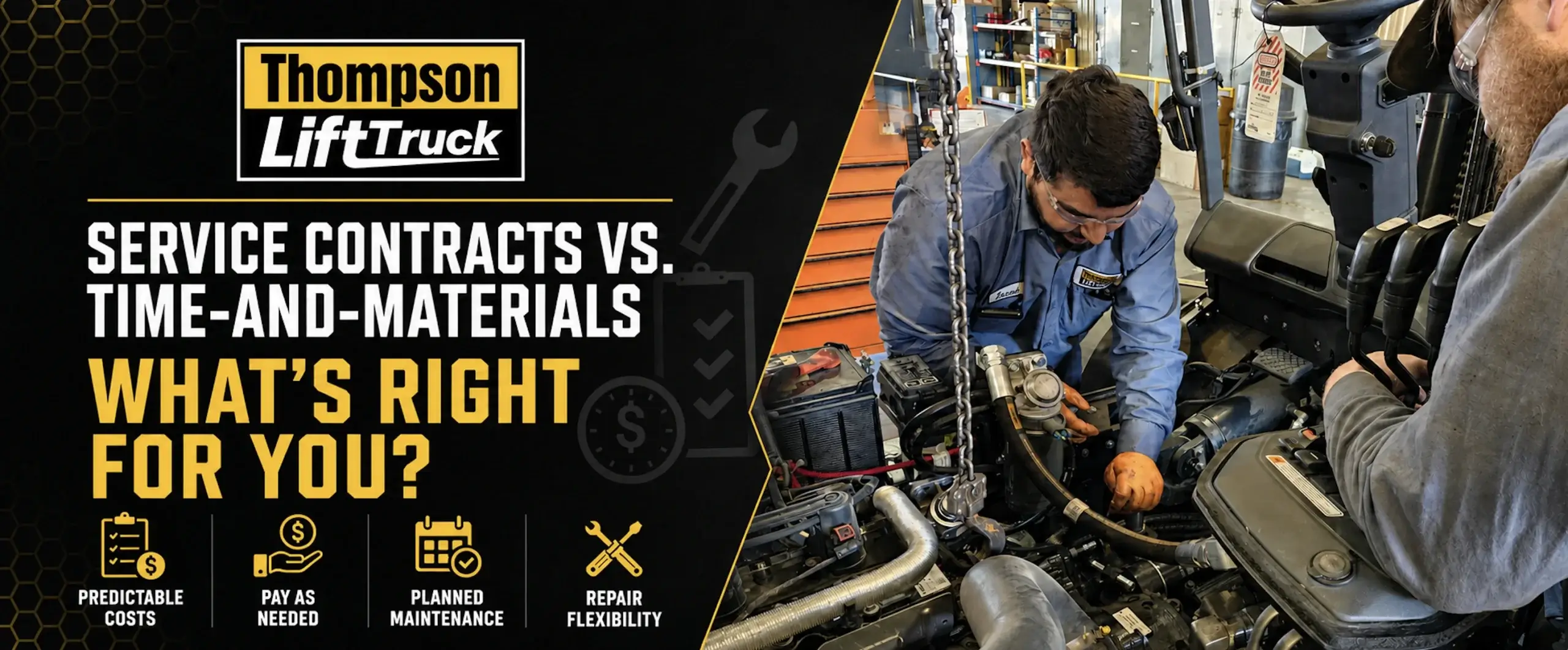
Every fleet eventually hits the same fork in the road: keep paying for forklift repairs one invoice at a time, or move to forklift service contracts and make maintenance a fixed line in the budget. There is no single right answer. The better choice depends on how many trucks you run, how hard they work, and how much a surprise breakdown actually costs you.
Here is how forklift service contracts stack up against time-and-materials billing, and how to tell which one fits your operation.
What is a forklift service contract?
A forklift service contract is an agreement where you pay a set, recurring fee and we handle maintenance on a planned schedule instead of waiting for something to break. Most of these (you will also see them called a forklift maintenance contract or a forklift service agreement) bundle the predictable work so it stops being a string of surprise bills. Here is what a contract typically covers.
- Scheduled preventive maintenance visits at set intervals, tied to run hours or the calendar.
- Routine inspections, fluid and filter changes, and wear checks before parts fail.
- Priority response when a covered truck does go down, so you are not at the back of the queue.
- Depending on the plan, parts and labor for covered repairs, or those billed separately.
The point of a contract is fewer surprises. You know what maintenance costs, when it happens, and who shows up. For the service intervals that sit behind most plans, our guide to preventive maintenance breaks it down.
What does time-and-materials forklift repair mean?
Time-and-materials means exactly what it says. When a forklift needs work, you pay for the technician’s time and the parts used, and nothing in between. No monthly fee, no contract. You call when something breaks, we fix it, and you get an invoice for that job.
It is the simplest arrangement, and for some fleets it is the cheapest one going. If your trucks are newer, lightly used, and rarely down, paying per repair can beat a contract you barely touch. The catch is that every bill is a different size, and the big ones tend to land at the worst possible moment.
Service contract vs time-and-materials: which controls costs better?
Neither is automatically cheaper. A service contract controls your budget; time-and-materials controls your spend. A contract turns maintenance into a flat, predictable number you can plan a year around. Time-and-materials keeps your costs tied to what actually breaks, which is great right up until three trucks go down in the same month.
The honest forklift repair cost comparison is not contract price versus repair price. It is total cost with downtime included. A contract usually looks more expensive on paper in a quiet year. It usually wins in a busy one, because planned maintenance catches problems before they turn into emergency repairs, and emergencies are where the money goes.
When does a forklift service contract make financial sense?
A service contract usually pays off once you have enough trucks, enough run hours, or enough riding on uptime that a breakdown costs real money. The more your operation depends on every forklift being available, the more a contract earns its keep. Look hard at one if any of these sound like you.
- You run a larger fleet, where the odds of something being down at any given moment are high.
- Your trucks are high-hour units working multiple shifts, where wear never really stops.
- A single hour of downtime stalls picking, loading, or a production line.
- You need predictable budgeting and cannot absorb a surprise five-figure repair month.
At that point the contract is not really about the maintenance. It is about protecting uptime and killing the budget swings. If you are coordinating service across a growing fleet, that gets easier when it all runs on one plan.
Not Sure Which Service Model Fits Your Fleet?
When is time-and-materials the better call?
Time-and-materials makes more sense when your exposure is low: a small fleet, newer or low-hour trucks, and an operation that can shrug off the occasional day of downtime. If you would barely use a contract, paying per repair keeps that money in your pocket.
A two-truck shop running a single shift on newer equipment probably does not need a contract yet. Neither does a seasonal operation where the forklifts sit idle half the year. The real mistake is staying on time-and-materials out of habit after your fleet and your hours have quietly grown past the point where it still makes sense.
How do you weigh downtime risk?
Downtime risk is the piece that decides most of these calls, and it is easy enough to estimate. Multiply what one hour of a forklift being down actually costs you (lost labor, stalled shipments, overtime to catch up) by how many hours a typical breakdown takes to resolve. Then ask how often that happens across the fleet.
If a down truck costs you a few hundred dollars an hour and a real repair takes a day or two with parts on order, one bad breakdown can swallow a year of contract fees. Run that number honestly. Most teams underprice downtime because the cost is scattered across labor, shipping, and overtime instead of landing on a single invoice.
Signs you have outgrown time-and-materials service
If repairs are starting to feel constant, you have probably outgrown reactive service. The clearest sign you need a contract is simple: breakdowns have stopped being rare events and turned into a regular line item.
- You are calling for emergency repairs more often than scheduled maintenance.
- The same trucks keep coming back for the same problems.
- Repair invoices are climbing year over year and you cannot predict them.
- A breakdown has cost you a shipment, a shift, or a customer in the last few months.
- You have added trucks or hours but never revisited how you handle service.
Any two of those together usually means the math has flipped. Staying reactive past that point is the most common, and most expensive, mistake we see.
How Thompson Lift Truck helps you choose the right service structure
You do not have to guess. We look at your actual fleet, your run hours, and your repair history, and we tell you honestly whether a service contract or time-and-materials makes more sense for your operation. Sometimes the answer is a mix: a contract on the high-hour trucks, pay-per-repair on the rest. We handle forklift service and maintenance across Alabama, GA, Florida, MS, and TN, so we can build a plan around how you really run instead of a one-size template.
Ready to control forklift repair costs? Contact Thompson Lift Truck to compare service contracts and time-and-materials support, or schedule a service to get started.
Frequently Asked Questions About Forklift Service Contracts
A service contract is a set recurring fee for scheduled maintenance and priority repair, while time-and-materials bills you per job for parts and labor only when something breaks. Thompson Lift Truck can compare both against your fleet and run hours and recommend the better fit.
Most cover scheduled preventive maintenance, inspections, and priority response, with parts and labor either bundled or billed separately depending on the plan. Thompson Lift Truck builds the coverage around your equipment and how hard it works.
Often not, if your trucks are newer, lightly used, and rarely down, since you can end up paying for coverage you barely use. Thompson Lift Truck can look at your fleet and tell you honestly when a contract starts to pay off.
It means you pay only when a forklift needs work, billed for the technician’s time and the parts used, with no monthly commitment. Thompson Lift Truck offers time-and-materials service across the Southeast for fleets that do not need a contract yet.
Neither is automatically cheaper. A contract tends to win in a busy repair year, time-and-materials wins in a quiet one, and downtime usually tips the scale. Thompson Lift Truck can run the comparison against your real repair history.
When emergency repairs start outnumbering scheduled maintenance and repair bills get hard to predict, it is usually time. Thompson Lift Truck can review your fleet and repair history and flag when the switch makes financial sense.