
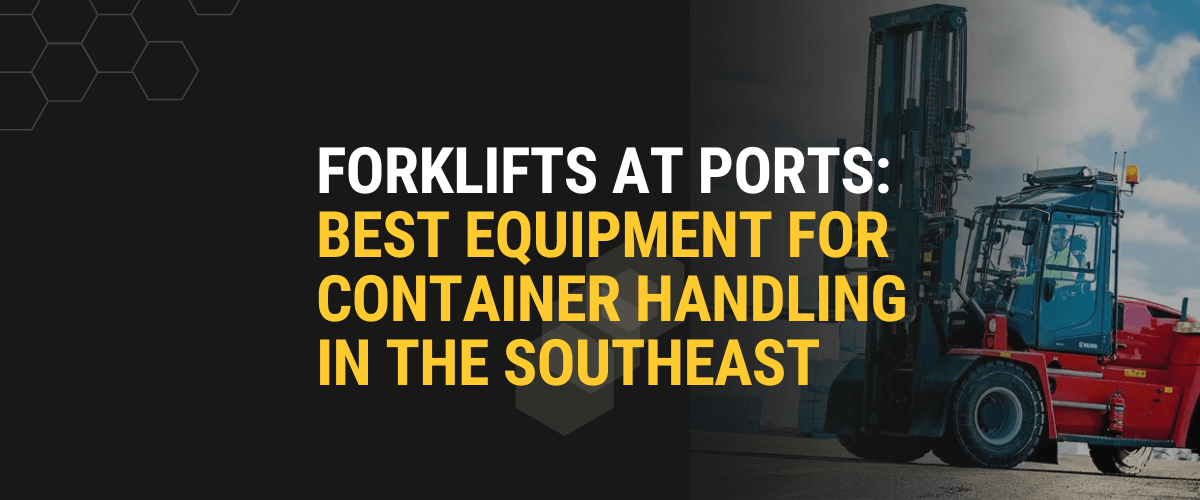
Forklifts at Ports: Best Equipment for Container Handling in the Southeast
Written by a Thompson Lift Truck Forklift Expert • Updated April 15, 2026
Quick Facts: Port and Container Equipment
- Standard loaded containers weigh up to 67,000 lbs, requiring high-capacity heavy-duty lifts.
- Reach stackers, empty container handlers, and dedicated laden container lift trucks.
- Kalmar forklifts are the global industry standard for durability and port productivity.
- Thompson Lift Truck provides specialized heavy-lift support across Alabama, Florida, and Georgia ports.
Looking for Forklifts for Container Handling?
When a massive container ship docks at a Southeastern port, the clock starts ticking. Success in port operations depends on how fast and safely you can move cargo from the ship to the yard and onto a truck or railcar. Choosing the right forklifts for container handling is the difference between a fluid supply chain and a massive bottleneck.
The High Stakes of Port Logistics
Port container handling requires specialized heavy-lift equipment, because standard warehouse forklifts are not built for the weight, height, or environment. Unlike a standard warehouse where pallets are uniform, port operators deal with massive weights, high stacking requirements, and harsh, salty environments. To keep up with the volume at major hubs like Savannah or Mobile, you need more than just a big truck; you need an integrated fleet of container handling equipment.
If you are new to the logistics side of heavy cargo, you might want to review the basics of moving shipping containers with a forklift before investing in your next machine.
Top Choices for Forklifts for Container Handling
Not all “heavy” forklifts are created equal. Depending on your yard layout and whether you are moving “laden” (full) or “empty” containers, your equipment needs will change.
Reach Stackers: The Versatile Workhorse
Reach stackers are often the preferred choice for port operators in the Southeast. Unlike a traditional forklift, a reach stacker uses a boom to lift containers.
- They can reach over the first row of containers to grab one in the second row.
- They are perfect for transferring containers from the ground to railcars.
- Because the load is held out in front or above, the operator often has a better line of sight compared to a masted truck.
Dedicated Laden Container Handlers
When you need to stack full containers high, a dedicated laden handler is the go-to. These are massive heavy duty forklifts for ports designed to handle 30+ ton loads with a mast. They offer a smaller footprint than reach stackers, which is vital if your yard has narrow aisles.
Why Kalmar Forklifts Lead the Industry
In port and container yard operations, equipment failure is a supply chain crisis. Kalmar builds machines specifically for the 24/7 cycle of a container terminal, and it shows in the specs, the uptime, and the total cost of ownership over a fleet’s lifetime. Thompson Lift Truck specializes in Kalmar equipment across the Southeast because it’s the brand port operators in this region trust when the stakes are high.
Eco-Friendly Power
Southeastern ports are under increasing pressure to reduce emissions. Kalmar leads the way with electric heavy-duty models that provide the same torque and lifting power as diesel, without the exhaust.
Precision Control
Moving a 40-foot container requires millimeter precision. Kalmar’s hydraulic systems allow operators to tilt, side-shift, and rotate containers smoothly, reducing the risk of damage to the cargo or the chassis.
Essential Features for Port Forklifts
When shopping for port forklifts, don’t just look at the price tag. Consider the total cost of ownership and the safety of your operators.
- Salt air eats metal. Look for machines with specialized coatings and sealed electrical components.
- Port operators often pull long shifts. Features like climate-controlled tilting cabs and joystick controls help prevent fatigue.
- Modern reach stackers in the Southeast should come with remote monitoring. This allows maintenance leads to see engine health and fuel levels in real-time.
Maintaining Your Heavy Equipment Fleet
A down machine at a port is a disaster. Container handling equipment operates under extreme stress, such as salt air, heavy loads, long shifts, and tight turnaround windows. At this intensity, maintenance cannot be an afterthought. A single unplanned breakdown during peak operations can hold up an entire vessel discharge, with knock-on delays that ripple across your supply chain.
Local Support Matters
Buying a machine is only the first step. You need a partner who can get a technician to the docks quickly. Thompson Lift Truck understands the unique pressures of port logistics. We provide on-site service and have one of the largest inventories of heavy-lift parts in the region.
Planned Maintenance for Heavy Lifts
High-capacity machines require specialized lubricants and hydraulic checks that standard forklifts do not. A planned maintenance agreement ensures that your mast chains, spreaders, and tires are inspected before a failure occurs.
Choosing the Right Reach Stackers in the Southeast
If your operation is expanding into intermodal logistics, reach stackers offer the best flexibility. They allow you to turn a small yard into a high-density storage area.
When choosing a reach stacker, consider:
- The Spreader: Ensure it can handle both 20-foot and 40-foot ISO containers.
- The Wheelbase: A longer wheelbase provides more stability but requires more turning room.
- Lifting Capacity at Reach: Remember that a reach stacker’s capacity drops the further the boom is extended.
Partner with a Heavy Lift Specialist
Managing a port or container yard is a high-pressure job. You need equipment that is as tough as the environment it works in. By choosing the right forklifts for container handling and a reliable service partner, you can ensure your terminal stays productive and safe.
Thompson Lift Truck is proud to support the engines of the Southeast’s economy. From the smallest pallet jack to the largest Kalmar reach stacker, we have the tools and the expertise to keep you moving.
FAQs: Forklifts for Container Handling
What is the best forklift for container handling at a port?
The best forklifts for container handling depend on whether you are moving full or empty containers. Reach stackers like the Kalmar DRF are the most versatile option for mixed yards, while dedicated laden handlers like the Kalmar DCE are better suited for high-volume full container stacking. Thompson Lift Truck can assess your yard layout and recommend the right configuration for your operation.
What is the difference between a reach stacker and a laden container handler?
A reach stacker uses an extending boom to lift and reposition containers across multiple rows, making it the more flexible option for smaller yards. A laden container handler uses a mast system and is designed for stacking full containers at high volume in a fixed lane layout. Both are available through Thompson Lift Truck across Alabama, Florida, and Georgia.
How much can a reach stacker lift?
The Kalmar DRF reach stacker lifts up to 45 tonnes in the first row, dropping to around 25 tonnes at maximum boom extension. Capacity at reach is one of the most important specs to confirm before purchasing, as a machine that meets your first-row requirement may not meet your second or third-row needs. Thompson Lift Truck’s heavy lift specialists can walk you through capacity curves for each Kalmar model.
What forklift do I need to lift a loaded shipping container?
A standard loaded ISO container can weigh up to 67,000 lbs, around 30 tonnes. You need either a dedicated laden container handler or a high-capacity reach stacker rated for that load at the required lift height. Standard warehouse forklifts are not built for this. Thompson Lift Truck specialises in heavy duty forklifts for ports and can source and support the right machine for your terminal.
Are Kalmar forklifts available in electric or hybrid models?
Yes. Kalmar offers electric and hybrid configurations across the DCE laden handler, DRF reach stacker, and ESC empty container handler ranges. Hybrid models can reduce fuel consumption by up to 25% in active duty cycles. Thompson Lift Truck can advise on which power configuration suits your yard layout, shift pattern, and any local emissions requirements at your port.
Where can I find heavy duty forklift service near me in the Southeast?
Thompson Lift Truck provides planned maintenance and emergency repair for heavy port equipment across Alabama, Florida, and Georgia. With one of the largest inventories of Kalmar heavy-lift parts in the region, service visits are completed on schedule without extended wait times for parts.
What is a planned maintenance agreement for port forklifts?
A planned maintenance agreement is a structured service schedule built around your fleet, shift patterns, and equipment type. For forklifts, it covers hydraulic checks, mast chain lubrication, spreader inspection, tyre assessment, and error code review at regular intervals. Thompson Lift Truck offers planned maintenance agreements for Kalmar and other heavy-lift equipment across the Southeast.