
Need a Short-Term Forklift Rental Fast? Here’s How to Keep Your Operation Moving
Written by a Thompson Lift Truck Forklift Expert • Updated March 13, 2026
Quick Facts: Short-Term Forklift Rentals
- Short-term rentals are available by the day, week, or month depending on your need
- Common use cases include inventory counts, warehouse re-layouts, temporary volume spikes, and equipment downtime coverage
- Matching the right truck to the job keeps productivity up and risk down
- Southeast operations can get fast delivery from us across Alabama, Georgia, Florida, Tennessee, Mississippi, Kentucky, and South Carolina
- Short-term rentals require no long-term financial commitment and include maintenance support
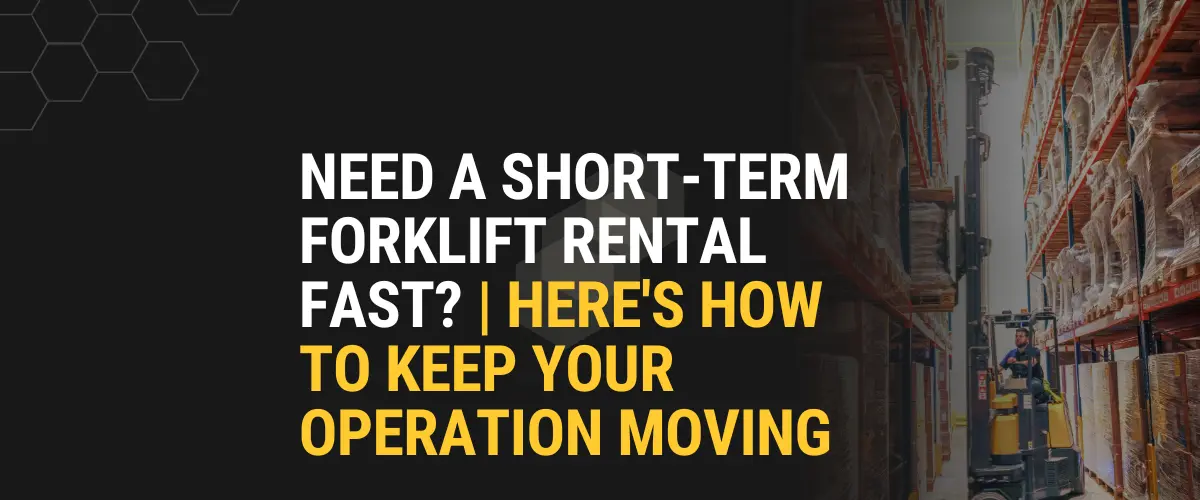
Need a Short-Term Forklift Rental Fast?
Inventory counts don’t wait. Neither does a warehouse reconfiguration, a temporary labor surge, or a piece of equipment sitting down at the worst possible time.
When your operation hits a short-term crunch, renting a forklift is often the fastest, most cost-effective way to keep things moving without committing to new equipment. But only if the right truck shows up quickly and your team can put it to work right away.
This guide covers the most common scenarios where a short-term forklift rental makes sense, what to look for when you need one, and how to avoid the usual delays.
When Does a Short-Term Forklift Rental Make Sense?
Short-term rentals come up for a lot of different reasons. Most of them are operational pressure points where you need more lift capacity right now but don’t need to buy a truck or sign a multi-year lease to solve the problem.
Annual and Quarterly Inventory Counts
Inventory counts slow everything down. Most facilities run with just enough equipment for daily operations, which means a full physical count creates a bottleneck. Your regular forklifts are tied up moving product while the count team needs to access every rack, every pallet, every corner of the building.
Adding a rental unit during count week lets your normal operations continue while the count proceeds on schedule. That’s a short-term forklift rental that pays for itself quickly, especially when you factor in what overtime costs if the count runs long.
Warehouse Re-Layouts and Racking Changes
Moving racking is one of the most labor-intensive projects a warehouse team takes on. It’s usually done in sections, often over nights or weekends, and it requires sustained lift capacity that your daily equipment isn’t built to absorb.
A temporary forklift rental for warehouse reconfiguration gives you the extra truck you need to move rack sections, reposition heavy shelving, and stage materials without pulling your primary fleet off regular work. When the project is done, the rental goes back.
Facility Expansions
Expanding into a new space or a new building typically creates a short gap between when you need lift capacity and when you’re ready to add a permanent unit to your fleet. A short-term rental bridges that gap cleanly, with no lease obligation and no capital tied up in a truck you’re not sure you need long-term yet.
Temporary Labor Increases
Seasonal surges, large contract fulfillments, and new customer onboarding can all spike your volume fast. If you’ve hired temporary operators to handle the load, they need equipment. Renting short-term scales your fleet with your workforce rather than forcing one to carry the other.
Equipment Downtime Coverage
This one doesn’t get planned for, but it happens constantly. A forklift goes down for a major repair. Parts are on order. The shop has a two-week backlog. Your operation doesn’t have two weeks.
A rental forklift covers that downtime without pressure. It keeps your dock moving, your shifts on schedule, and your team from spending the whole day working around a gap in the fleet. For ongoing forklift service and maintenance, we can help with that too.
What to Think About Before You Rent a Forklift
Getting the right truck matters as much as getting one fast. The wrong equipment type, the wrong capacity, or the wrong fuel source can make a rental more disruptive than helpful.
Capacity and load type. Know the maximum load you’ll be moving and the weight of the heaviest pallet or item. Most warehouse applications fall between 3,000 and 6,000 lbs, but if you’re handling heavier loads, confirm the rental unit is rated for it.
Fuel type. Indoor facilities generally require electric or propane equipment. If you’re weighing fuel types for your operation more broadly, our guide on diesel, propane, or electric forklifts breaks down the tradeoffs. If you’re renting for an indoor warehouse count or re-layout, confirm the fuel source before the truck is dispatched.
Mast height and aisle width. Verify the mast height matches your rack height and that the turning radius fits your aisle configuration. A truck that lifts high enough but can’t maneuver in your space adds time, not efficiency.
Operator certification. OSHA requires that forklift operators are trained and authorized for the specific type of equipment they operate. If the rental is a different class of truck than what your team normally runs, factor in a brief orientation before the first shift. We offer operator safety training if your team needs it.
How to Keep a Short-Term Rental from Slowing You Down
Most short-term rental problems aren’t about the equipment itself. They’re about preparation. The same issues that delay a delivery or create day-one friction are almost always preventable.
Have your site ready before the truck arrives. That means clear access for the delivery vehicle, confirmed fuel or charging setup, and a designated contact on site who can sign off on the unit. For more detail, see our forklift rental delivery checklist.
Be specific about how long you need the truck. Short-term rentals can usually be extended if your project runs long, but we need notice. If you’re flexible on the timeline, say so upfront.
Communicate the application clearly. An inventory count on smooth warehouse floors has different equipment requirements than a re-layout that involves outdoor staging. The more specific you are about the job, the more likely you get the right truck the first time.
Why Southeast Operations Rely on Us for Short-Term Rentals
We provide short-term forklift rentals across the Southeast, with dedicated rental pages for Atlanta, Nashville, Birmingham, Augusta, Huntsville, Knoxville, and more. Our rental fleet includes electric, propane, and diesel forklifts in a range of capacities, with fast delivery and local service support built in.
When you call us for a short-term rental, you’re talking to people who know material handling. We’ll ask the right questions, match you to the right equipment, and get the truck to your site without unnecessary back-and-forth.
No long-term commitment. No purchase required. Just a forklift that shows up ready to work when your operation needs it.
Need a short-term forklift rental fast? Contact us and keep your inventory count or re-layout on schedule.
FAQs: Short-Term Forklift Rentals
What is a short-term forklift rental?
A short-term forklift rental is equipment rented by the day, week, or month for temporary operational needs, with no long-term lease or purchase commitment. We offer short-term rentals across the Southeast for projects like inventory counts, re-layouts, and downtime coverage.
How fast can I get a forklift rental delivered?
Delivery speed depends on equipment availability and your location, but most short-term rentals can be arranged within one to two business days. We serve operations across Alabama, Georgia, Florida, Tennessee, Mississippi, Kentucky, and South Carolina.
Can I rent a forklift just for an inventory count?
Yes. Renting a forklift for an inventory count is one of the most common short-term rental use cases. A temporary unit lets your operation keep moving while the count team works through the facility without creating a bottleneck.
What’s the difference between a short-term forklift rental and a lease?
A short-term rental covers days, weeks, or a few months with no long-term financial obligation. A lease typically runs one to five years and includes structured payments. Rentals are better suited for temporary spikes, projects, or downtime coverage. We offer both options depending on your needs.
Do I need a forklift operator certification for a rental?
OSHA requires that anyone operating a forklift is trained and authorized for that specific equipment type. If your rental unit is a different class than what your team normally runs, a brief orientation is required before the first shift.
Can I extend a short-term forklift rental if my project runs longer than expected?
In most cases, yes. Extensions depend on equipment availability, so let us know as early as possible. We can work with you on extensions to avoid gaps in coverage.
Where does Thompson Lift Truck provide short-term forklift rentals?
We provide forklift rentals across the Southeastern United States, including Alabama, Georgia, Florida, Mississippi, Tennessee, Kentucky, and South Carolina. Contact our team to confirm availability in your area.